







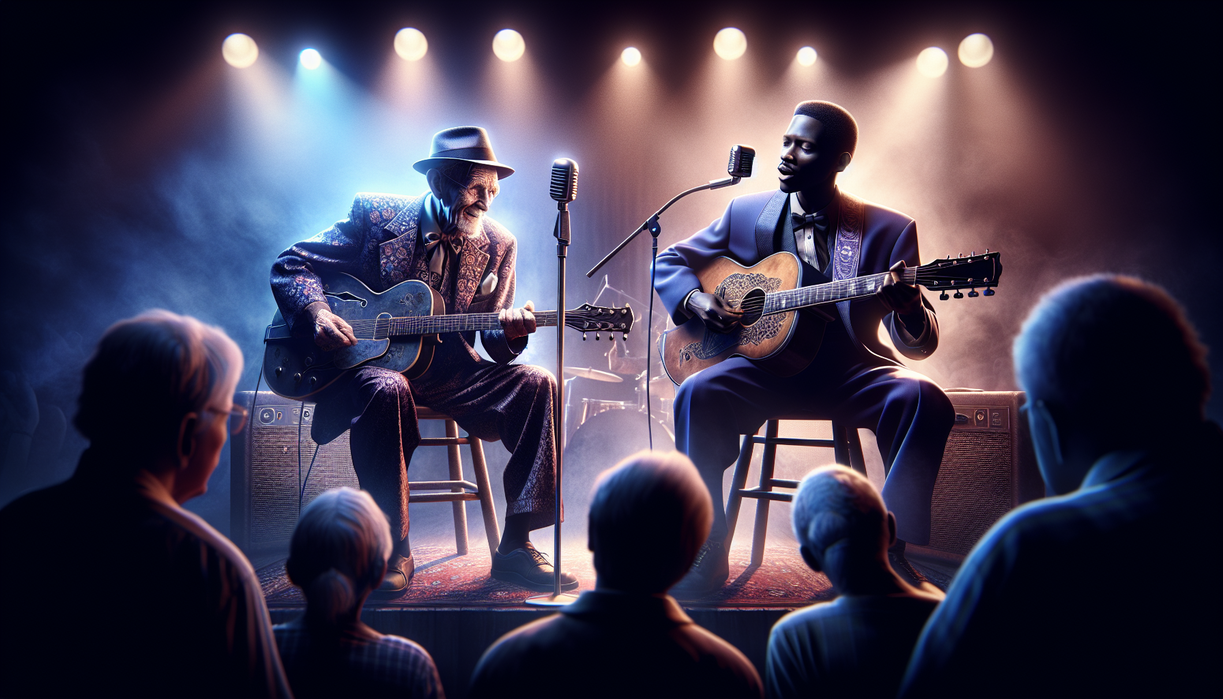
www.twotwoart.com – The content context of a single night at Buddy Guy’s Legends can tell you more about the future of blues than a dozen think pieces. When Gary Clark Jr. walked onto that storied Chicago stage with Buddy Guy himself, it felt less like a routine tour stop and more like a chapter closing, another one beginning, both artists writing in the same ink of amplified emotion.
Framed in that content context, the performance became a living document of the genre’s survival instincts. The veteran and the heir apparent did not just share songs; they shared responsibility. Every solo, every shout from the crowd, every shared grin between the two guitarists sketched a roadmap for how blues can stay urgent, electric, and undeniably current.
The power of content context at Legends
Buddy Guy’s Legends has always been more than a room with a small stage and framed photos. It lives as a cultural memory bank. When Clark set up his pedalboard beneath those photos, the content context of the venue reshaped his songs. Riffs carried echoes of Muddy Waters, Howlin’ Wolf, Junior Wells, yet they also pulsed with modern anxieties, love stories, and fractured politics.
That layering of eras gave each tune a doubled weight. Past and present overlapped, never competing, more like two guitars playing complementary lines. You could hear the old Chess Records spirit floating around the speakers, though Clark’s tonal palette stayed richly contemporary. Thick fuzz tones, shimmering delays, and subtle R&B inflections turned established 12‑bar structures into forward‑leaning narratives.
From my perspective, the most striking thing was how the room altered perception of Clark’s catalog. Songs you might stream in passing took on new urgency inside this content context. Under those blue lights, they sounded like arguments for why blues can thrive streamed in high fidelity, sampled by producers, or blasted from festival main stages without losing its backbone.
Gary Clark Jr. returns to his roots
Clark has played massive festivals, late‑night television, and international arenas, yet this return to a club setting tightened his focus. In such close quarters, there is nowhere to hide. The content context of a small, iconic venue forces honesty. Every bend reveals how deeply a player believes the story they tell through six strings. Clark rose to that test with grimy, muscular tone and sharp dynamic control.
He leaned heavily on slow‑burn grooves, where the silence between notes felt as eloquent as each flurry of vibrato. Phrasing came across deliberate, less about technical fireworks, more about landing emotional punches. In a broader content context, where modern guitar heroes often chase speed or spectacle, Clark’s patience felt quietly radical. He let songs breathe, confident that a single sustained note could say what a faster run might dilute.
Watching him navigate that space, I felt he has reached a new phase of maturity. Early in his career, the conversation often revolved around potential. Now the content context has shifted toward stewardship. He appears less concerned with proving himself and more focused on holding a line between tradition and experimentation, keeping one foot firmly in Texas blues soil while the other explores soul, rock, hip‑hop textures, even cinematic soundscapes.
Buddy Guy steps in: a living bridge
When Buddy Guy finally strode onto the stage, the content context flipped from impressive club gig to ceremonial handoff. The crowd’s reaction made it clear that this was not just a cameo but a symbolic act. Guy’s presence fused nearly seven decades of lived blues history with Clark’s unfolding narrative, creating a living bridge that spanned Jim Crow era juke joints, ’60s British invasion aftershocks, and today’s fractured streaming culture. Guy teased the younger player with playful licks, call‑and‑response phrases, and that unmistakable vocal rasp, yet beneath the humor sat a serious message: this music survives only if each generation takes the flame and adds new fuel without dousing the original spark. In that moment, the content context reached its peak clarity; the past did not retreat into nostalgia, it stepped forward, put an arm around the future, and walked it right into the spotlight.
The emotional grammar of the blues
The set offered a reminder that blues is a language with its own grammar. Bends, slides, call‑and‑response exchanges, these elements construct emotional sentences. In this content context, you could almost diagram each solo like a paragraph. Clark often opened with understated motifs, gently testing the room, then gradually stacked intensity until the narrative reached a breaking point, only to fall back into a hush that felt like a quiet confession.
Buddy Guy’s contributions used similar grammar yet with different punctuation. Where Clark favored long arcs, Guy loved exclamation points. Sudden bursts of volume, abrupt high‑register screams, strategic pauses followed by a mischievous grin. That interplay between two styles revealed blues as flexible storytelling, not a fixed museum piece. The content context of mentor beside student allowed listeners to compare dialects within the same language.
Personally, I found that conversational quality more moving than any fretboard fireworks. When Clark mirrored Guy’s licks, adjusting them with his own phrasing, you could hear respect rather than imitation. It felt like two relatives defending the same family story from different vantage points. In a broader content context where music can slip into background noise, these exchanges demanded full attention, inviting the audience to listen as participants, not passive observers.
Blues in the era of streaming and genre blur
Outside the club, the music world lives inside algorithms, playlists, inevitable genre mixing. Many worry that blues becomes diluted or sidelined in such an environment. The performance at Legends pushed against that anxiety. Inside this content context, blues did not sound like a relic; it sounded like raw source material. You could hear how beats, hooks, and textures from other genres trace back to these riffs and shuffles.
Clark’s catalog already reflects that blur. Certain songs carry R&B harmonies, others flirt with psychedelic rock or subtle hip‑hop cadences. Yet the emotional core stays unmistakably blues. This show proved that fusion need not equal erasure. Instead, it can act as expansion. In my view, the key lies in content context. When artists center the tradition even while experimenting, each new layer strengthens the foundation instead of cracking it.
Buddy Guy’s presence acted as real‑time quality control. If any innovation rang false, his reaction would have shown it. Instead, he seemed delighted, even invigorated, by Clark’s modern spin. That approval, offered not through words but through shared solos and nods, gave the evening a rare authority. It suggested that the guardians of the old ways believe in today’s evolution, provided the heart of the music remains rooted in truth rather than novelty chasing.
Why this night will matter in hindsight
Looking ahead, I suspect critics and fans will point to this show as more than a memorable concert. They will see it as a snapshot of blues at an inflection point, captured within a rich content context. A giant of the past stood side by side with a leader of the present, inside a venue that itself functions as an archive. Together they offered a thesis: blues thrives when it embraces continuity over replication, when it allows younger voices to reinterpret older codes without abandoning them. For those willing to pay attention, the night at Buddy Guy’s Legends delivered a reflective lesson no panel discussion could match. It showed how music carries history forward not through speeches or plaques but through fingers on strings, sweat on stage floors, and shared looks between generations that say, without a word, this story is yours now—guard it, change it, but never let it fade.