










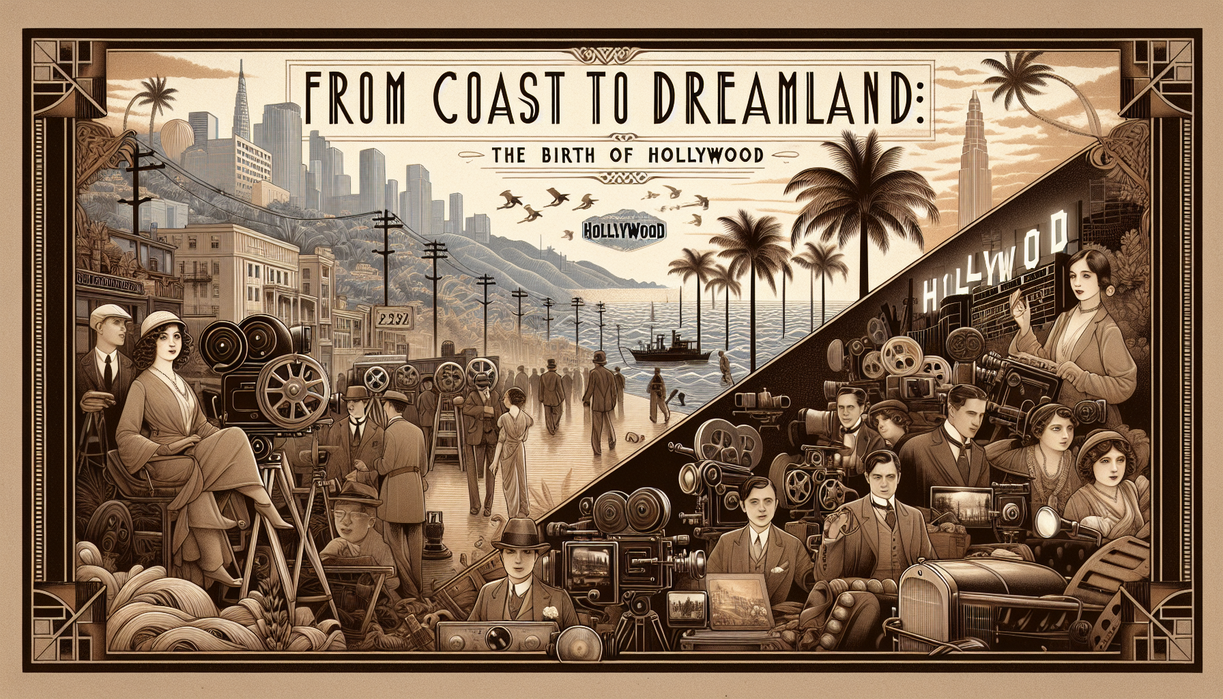
www.twotwoart.com – To grasp the rise of Hollywood, we must start with context. Before palm trees framed studio gates, motion pictures grew on the opposite coast. Early filmmakers shot short, flickering reels near New York and New Jersey, close to theater districts, financiers, and existing entertainment hubs. Yet hidden inside this early success was a tension between rigid control and restless innovation. That tension eventually pushed studios, directors, and producers to look west, toward a region with sunlight, open land, and fewer legal constraints on creative work.
Seen in context, Hollywood did not appear overnight as a glamorous dream factory. It emerged through conflict, legal battles, shifting technology, and harsh economic choices. By the 1920s, what started as an experiment on California soil had turned into the world’s dominant movie capital. Understanding how this migration unfolded reveals how geography, law, culture, and ambition fused into an industry capable of shaping global imagination.
The East Coast Origins in Historical Context
At the start of the twentieth century, cinema’s power hubs sat firmly on the East Coast. Production houses clustered near New York because stage talent, camera suppliers, and investors were already present. Urban theaters gave filmmakers quick feedback, while publishers and critics documented the new medium. In this early context, movies felt like an extension of vaudeville and theater, not yet a separate global industry.
However, the legal context around patents soon tightened. Thomas Edison and associated companies controlled crucial motion picture technologies through a powerful patent pool. Independent producers faced lawsuits, threats, and equipment seizures when they tried to operate outside that system. Film creativity collided with a business environment heavily shaped by ownership of technical foundations rather than pure storytelling skill.
This restrictive context made many filmmakers search for physical distance. California, especially the Los Angeles area, offered exactly that. Its remote location kept independent producers far from aggressive patent enforcers. At the same time, the region promised affordable land, various landscapes, and almost year-round sunshine. These practical conditions transformed the West Coast from a distant thought into a strategic refuge for ambitious producers.
The California Shift and the Birth of Hollywood
When early film pioneers arrived in California, Hollywood existed mainly as a quiet community outside Los Angeles. The area’s identity depended on agriculture more than art. Yet the local context suited moviemaking perfectly. Mountains, ocean, deserts, and city streets sat within short travel distance, allowing crews to simulate multiple regions of the world without leaving Southern California.
Climate provided another decisive advantage. Clear skies simplified outdoor shooting and reduced reliance on fragile early lighting technology. Longer workdays increased productivity, something extremely valuable in an era when film stock cost serious money and cameras remained bulky. In this context, every hour saved during production meant a competitive edge over East Coast rivals locked into more unpredictable weather.
Costs also played a pivotal role. Land near Hollywood was cheaper than property near New York studios. Small producers could build stages, storage spaces, and experimental sets without massive investment. This economic context nurtured a culture of risk-taking. Companies could test genres, visual tricks, and new narrative forms with fewer financial fears. Over time, this risk-friendly environment fueled rapid stylistic evolution across the entire industry.
How Hollywood Became the Global Movie Capital
By the 1920s, Hollywood’s dominance rested on more than sunshine and cheap real estate. The region had developed a full industrial ecosystem, one that turned films from local curiosities into global commodities. Within this context, large studios controlled production, distribution, and exhibition through integrated systems. Their efficient pipelines allowed rapid output of feature-length stories aimed at worldwide audiences. My view is that Hollywood succeeded because it learned to treat movies as both artistic projects and standardized products. That dual awareness shaped its storytelling style: emotionally accessible, visually clear, and easy to export across cultures. In turn, global enthusiasm reinforced Hollywood’s confidence, creating a feedback loop where commercial success justified even greater technical investment and narrative experimentation.
Studio Systems, Stars, and Cultural Context
The so-called studio system provided structure for Hollywood’s growing influence. Powerful companies signed actors, directors, and writers to long contracts. That framework might appear restrictive today, but in historical context it offered stability, training, and steady work. Studios built schools, costume departments, and technical workshops that turned raw talent into polished on-screen personalities.
This environment nurtured the star system. Actors became recognizable brands whose appeal crossed regional borders. Here context mattered again: rising mass media, fan magazines, and radio turned performers into household names. Audiences followed particular stars rather than individual directors. While that shifted power dynamics inside studios, it also anchored Hollywood films within everyday conversation and fantasy across many countries.
Despite glamour, the cultural context surrounding Hollywood remained contradictory. On one side, films pushed progressive ideas, challenged traditional roles, and explored social issues through drama and comedy. On the other, censorship boards and moral watchdogs pressured studios to avoid controversial topics. Personally, I see this tension as central to Hollywood’s impact. It had to express desire, conflict, and ambition while staying inside boundaries that kept mainstream audiences comfortable. That balance shaped narrative formulas still recognizable today.
Technology, Global Reach, and Modern Reflections
Technological shifts constantly redefined Hollywood’s position. The arrival of sound in late 1920s altered the competitive context again, because studios with strong resources could adapt faster through new equipment and training. Later innovations such as color film, widescreen formats, and computer-generated imagery continued this pattern. Each leap raised production costs while deepening visual spectacle. From my perspective, Hollywood’s enduring advantage lies less in any single tool and more in its habit of absorbing technology into familiar storytelling structures. Even streaming platforms operate inside that tradition, distributing narratives built on century-old techniques of pacing, character arcs, and emotional payoff. Placed in a broad historical context, the migration from East Coast experiments to California empires illustrates how environment, law, technology, and culture converge to shape entire industries. Reflecting on this journey encourages us to question which present-day creative hubs might quietly be preparing the next transformation in global storytelling.